- Veiled Age Herald
- Posts
- Issue 9: Standard
Issue 9: Standard
In which I try to defend generic fantasy settings

Justin Mulwee
September 03, 2025
The first step is to be honest, and then to be noble.
When worldbuilding, honesty is the best policy.
Philosophers have pointed out that whenever you ask about the cause of something, there are often two ways you can answer. One is in terms of physical cause-and-effect, the other is in terms of agency and purpose.
For example, imagine a kid comes downstairs and sees a kettle of boiling water on the stove. The kid asks, "why is the water boiling?" Dad answers, "because the heat from the burner transfers to the kettle, exciting the water molecules until they transition from liquid to gas." But mom says, "because I wanted tea."
These are equally correct answers. In fact, both answers really just describe different events in the same chain: the desire for tea caused mom to turn on the burner, which caused the molecule excitement stuff. We might suspect that dad is being deliberately silly in emphasizing the technical answer. Mom's motive-based answer seems more sincere somehow. It cuts through the noise.
The same applies to worldbuilding. The real reasons for the core features of any fictional world have to do with the writer's personal fixations. Self-awareness regarding this is something we try to encourage in our local writer's workshops. When worldbuilding, writers should not neglect to ask WHY from a writer's perspective, not only from the perspective of the internal logic of their world.
For example, why is your sci-fi city built in the caldera of a dormant volcano? The tendency, especially for new writers, is to immediately answer with "You see, mile-deep wells bring up superheated steam that runs generators to power the city, and..." you get the idea. But of course, these are the imaginary considerations of imaginary engineers. When we ask "why" about a fictional universe, the buck ultimately stops with the only non-imaginary agent: the writer. What do they want?
A little reflection can help ensure the writer's worldbuilding activities line up with their emotional worldbuilding goals -- their honest motives. To begin, they should just admit that a volcano-city sounds awesome, and they love picturing a bunch of heavy machinery that would make it work. Once the writer is crystal clear on that, they can focus on the internal logic. "Okay, I'm obsessed with the idea of a volcano city. Given that premise, why might people build a city in a volcano? How would they mitigate the dangers?"
I’m sure there are other ways to design a world, but I suspect this is the best way for most of us: to reverse-engineer it. Start with what you want, then crack it open and see how it works.
In Praise of “Standard Fantasy”
The Veiled Age setting has some deliberately weird elements I think will lend some originality to its style and atmosphere, but that’s not what I want to discuss today. To a significant extent, the Veiled Age setting is intentionally a traditional high fantasy setting: a loose template started by Tolkien and, I'd argue, completed by Gary Gygax, who created Dungeons & Dragons. He took a Tolkienesque medieval world and mixed in the ideas of other seminal fantasy authors like H.P. Lovecraft (cosmic horror) and Robert E. Howard (sword and sorcery). The result is a picture considerably more expansive and weird than Tolkien, often containing the following things:
Multiple humanoid races
Low-tech society with magic
Dangerous wilderness with monsters
Ancient ruins and lost artifacts (dungeons and treasure)
Supernatural threats, such as undead, demons, or eldritch horrors
Prominent religious themes: Gods, temples, priests, cults
Cosmic themes, like outer space or other dimensions
In turn, D&D inspired Yuji Horii to create the video game series Dragon Quest, which went on to inspire other JRPGs, anime, and manga. I'd argue the overwhelming majority of popular fantasy can be clearly traced to this Tolkien → D&D → JRPG lineage.

But why write in such a world? Isn’t the concept of “standard fantasy” inherently lame? Shouldn’t things be as original as possible? Not necessarily. Here are some of my motives for building such a world to tell my stories in.
A pre-modern setting is more suitable to adventure.
Medieval fantasy probably became the norm because of Tolkien, but I’d argue it’s a good time period for characters to have adventures in. It’s modern enough to have recognizable societies with big cities, politics, international trade, and so on. At the same time, it lacks any of the conveniences that tend to suck the mystery and danger out of adventure:
Exploration is stronger with uncharted territory and untamed wilderness.
Messages are more dramatic when they must be physically carried by someone.
Horror is scarier without telephones to call for help.
Mystery works better when you can’t google anything.
Political plots are cleaner when there are kings and queens for them to hinge on.
For a journey to be epic, it must be physically exhausting (no vehicles).
A “generic” setting is less restrictive.
A typical fantasy world contains mismatched things amassed by tradition; it doesn’t revolve around a singular premise or location. Because of this, a wide variety of fantasy scenarios can be placed here, making it particularly suited to roleplaying games and ongoing series. Since Veiled Age is an episodic project, I need a springboard for writing fantasy stories without having to start from scratch every time.
I also don’t believe fantasy stories with a specific tone, premise or atmosphere require a monotone world that revolves around that thing. For example, I adore the anime Claymore, where nearly every character is a half-demon albino woman with a big sword. In a high fantasy world, something like that can easily exist in a corner somewhere as needed. Oddly enough, this makes the world feel more realistic. The real world contains mismatched items and unexplained oddities; it doesn’t simply conform to a theme.
On the other hand, if your world setting is a nuclear winter or the desert planet of Dune, you can’t even write a simple sentence like “Johnny went apple picking.” For an ongoing project, I don’t like feeling tied down like that.
Tradition implies natural selection.
This is my biggest reason. Classic tropes have stood the test of time. If elves, zombies, dragons, castles, and spellbooks weren’t compelling fantasies, they wouldn’t be so consistently present in fantasy settings. We should respect the fact that they have survived the long and painful process of literary natural selection.
Deliberately subversive, unconventional, or satirical fantasy has its place. But I rebel against the idea that unironic, conventionally moral, high fantasy adventures are somehow played out or childish. I want to build a world for people who share my positive gut reaction to images like this:
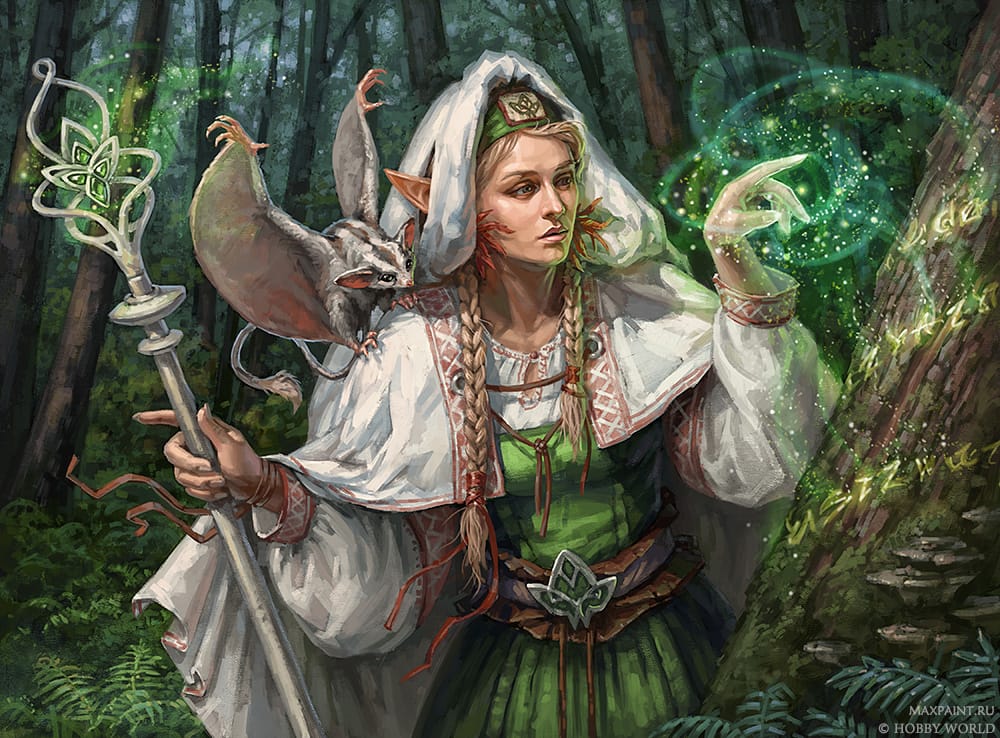
Artist: Ekaterina Burmak
Often, people pick up a fantasy story or game for the same reason they’d order a pizza: they have a particular craving. It’s simply delicious, and it’s also familiar, comforting and nostalgic. Sure, a secret sauce or an unconventional topping can spice things up. But imagine if 4 out of 5 pizza places were run by cynics trying to subvert the concept of pizza. That would just be annoying. But that's what it sometimes feels like to be a fan of western fantasy.
When we look at popular eastern fantasy, such as anime and video games, we see plenty of non-subversive works. Though the writing of these mediums can tend toward the immature and indulgent, they at least know how to deliver fantasy in the romantic sense, where there are monsters, bonds of loyalty, kingdoms to defend from evil, and so on.
Bottom line: I’m not here to look down on fantasy, but to satisfy the craving for it with a high quality product.
Familiar elements are more elegant than lore dumps.
By relying on the reader’s background knowledge of fantasy, I can use fantastical elements while limiting lore dumps to things that actually matter. Notice how the image above conveys a lot about the character due to its traditional fantasy archetype — no lore needed. In the same way, I could write “There once was an old dwarf who hunted vampires with his cursed axe,” and I wouldn’t need to halt the story to explain these ideas. We both have better things to do than wrestle with a zillion new fantasy words made I up for no reason. Don’t get me wrong, I love making up words (such as chime acuity, Heth or coldblood), but I want them to pull their weight.

Credit: XKCD